Reading a Defensive Line as It Moves Up
Reading a defensive line as it moves up helps you spot coordinated pressure, uneven spacing, and the channels defenders leave exposed as the attack unfolds.
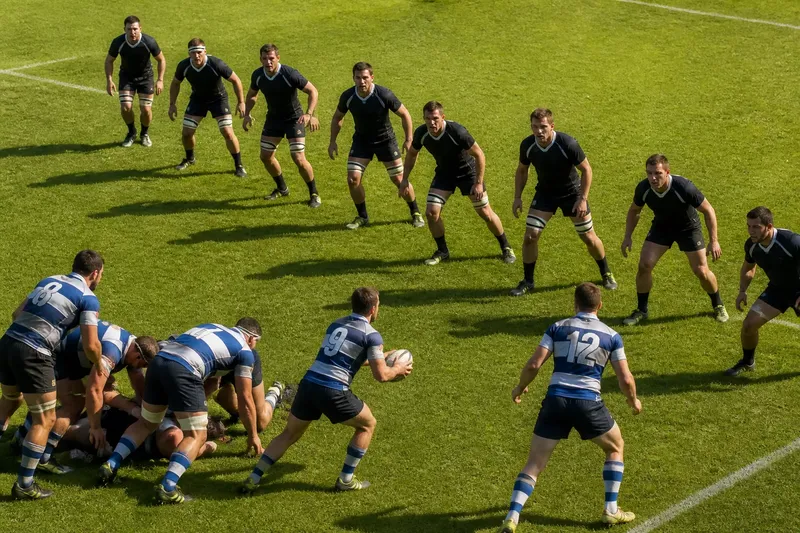
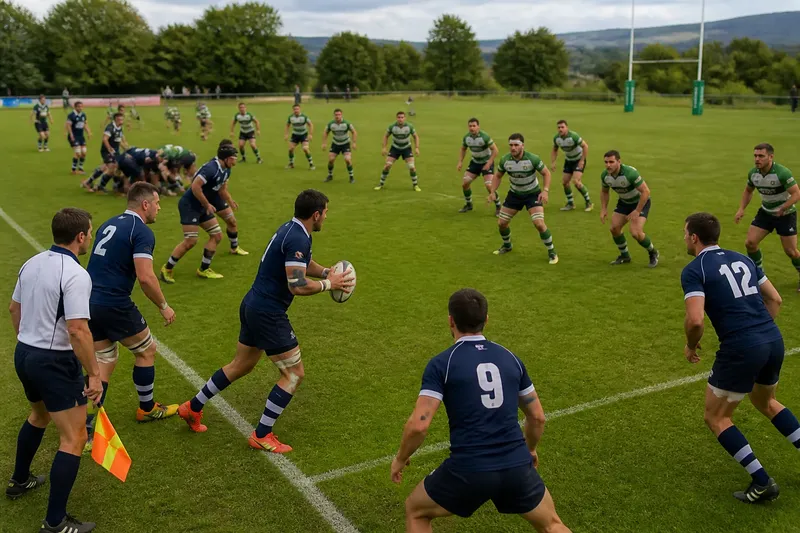
As the ball travels from a rugby ruck to the first receiver, defenders begin to step forward. Reading a defensive line as it moves up means watching their timing and spacing, not just the runner with the ball. Their feet, shoulders, and movement together can show where pressure is building and which areas they are trying to cover.
Find the line’s shape
Begin with the defenders nearest the ball carrier, then widen your view to include the players on either side. The line is not always straight. It may bow inward around a ruck, angle toward the touchline, or form a shallow arc as defenders prepare to advance. That shape affects which attacking options look available.
Look for the point where the line changes direction. A defender standing close to the ruck may step forward early, while the outside defenders hold their depth. That creates a slanted line, with defenders near the ball closer to the attack than those farther away. The angle can make the first receiver feel crowded while giving wider defenders more time to read the pass.
Spacing matters as much as shape. A tight line gives attackers less room to run between defenders, but it can leave space outside the last defender. A loose line covers more width, though a quick pass may expose a gap between teammates. Neither arrangement tells you by itself what the defense will do; it gives you a starting point for watching their next movement.
Use the touchline as a reference. If the defensive line is drifting toward one side before the attack reaches it, note whether the far-side defenders are also moving or merely waiting. A connected shift suggests the whole line is covering width. A delayed outside response may mean defenders are still organizing or focusing on the ball carrier’s immediate channel.
Track feet and shoulders
Feet often reveal a defender’s next action sooner than the upper body does. A player moving forward with short, balanced steps can usually adjust to the runner or a pass. A defender crossing their feet while turning sideways may be less able to change direction quickly. Watch for planted feet, a sudden pause, or a backward step as the attack approaches.
Shoulders provide another clue, but treat them as a clue rather than a promise. Shoulders square to the ball can indicate that a defender is preparing to meet the carrier. A torso turned toward the touchline may show that the defender is guarding against a pass or trying to shepherd the attack away from the middle. The relevant question is what the rest of the line does alongside that posture.
Imagine the ball moves from a ruck to a first receiver. The nearest defender advances with shoulders facing the receiver, while the next defender takes a short sideways step and keeps their chest angled toward the outside runner. The observable result is pressure on the ball with a defender still positioned outside; if that second defender turns toward the receiver, the apparent outside cover is changing.
Try following one defender for a few phases rather than switching your attention to every player. Notice where they stand before the pass, how their feet move as the ball travels, and whether they continue forward after the carrier releases it. This makes it easier to distinguish a real advance from a brief feint or a player simply adjusting position.
Notice the advance
A defensive line can move forward together, advance in sections, or hesitate while players reset. In a connected advance, several defenders step up at roughly the same time and maintain their relationship with one another. The pressure can shrink the attacker’s time to pass or run. If one player rushes ahead while teammates remain deep, the line may stretch into an uneven shape instead.
Watch the moment just before the ball reaches the next receiver. Defenders may begin moving as the pass travels, trying to close space before the receiver can make a choice. If the receiver catches the ball while defenders are still coming forward, the attack may have little time to settle. If the defense pauses or retreats, the receiver may have more room to assess options, though the line can still close once the ball is secured.
Do not judge movement only by how far a defender travels. A small, synchronized step can keep the line organized; a larger burst by one player can create a gap behind them. It is like a zipper closing: when the teeth meet in sequence, the opening disappears; if one side moves ahead of the other, a gap remains.
Also notice whether the advance continues after the pass. Some defenders keep moving toward the receiver; others hold their ground or shift toward a nearby runner. That change can show how the defense is dividing attention. If two defenders both turn toward the ball, an outside attacker may become less closely watched. If one stays focused on the runner, the passer may face pressure without the receiver being fully covered.
Read defensive connections
The useful unit is often not an individual defender but the connection between two defenders. Look at the distance between them, whether they move in the same direction, and whether one appears to be waiting for the other to engage the ball carrier. A narrow gap can close quickly if both players advance together. A widening gap can become an invitation, though the attack must still get the ball there in time.
Watch for defenders pointing, calling, or glancing sideways as the line shifts. Those gestures can indicate that players are communicating about who will take the carrier and who will cover the next attacker. You do not need to hear the words. The visible response is more useful: does a teammate step across to close the space, or does each defender continue tracking a different attacker?
The edge of the line deserves special attention. The last defender may stand deeper than the players inside, ready to cover a pass toward the touchline. Or they may advance early and leave the outside attacker with a brief chance to run into open space. Check whether the next defender inside is close enough to provide support. If not, the edge player may have to choose between pressing the ball and guarding the outside channel.
These cues can be hard to separate when players are moving quickly. Pick one connection to follow: perhaps the defender beside the ball carrier and the next defender outside them. If their spacing opens as they advance, note that. If one adjusts to restore the gap, note that instead. A focused observation is more reliable than trying to decode the whole field at once.
Follow the pass
The defense responds not only to the ball carrier but also to the speed and direction of the pass. A pass that travels across the field gives defenders time to shift, so watch whether the line moves with it or whether its far side lags. A short pass close to the ruck may bring a quick defensive surge, especially if defenders have already set their feet facing the ball.
Keep your eyes on the defensive players while the ball is in flight. The pass itself is easy to follow; the less obvious information is how defenders react before the catch. If they move together toward the receiver, the attack may meet pressure as soon as the ball arrives. If the nearest defender advances but the next players hold, the receiver may see a seam between them or find that the defense is waiting to contain a wider move.
It helps to distinguish a shift from a rush. In a shift, defenders slide across the field to stay opposite the ball. In a rush, they move forward to reduce the receiver’s space. The two can happen together, but the emphasis changes what the attack faces: lateral movement can make the outside route feel crowded, while a forward surge can make the receiver decide quickly.
Say you are watching an invented passage in which the ball moves from a ruck toward the right touchline. The inside defenders slide right, but the outside defender stays deep and steps backward as the pass travels. The observable result is a more cautious edge, with the receiver likely seeing room in front but a defender positioned to cover a longer pass. This reading does not predict the next play; it helps you identify the pressure the defense has chosen to apply.
What should you watch before contact?
What does a defender’s backward step mean?
A backward step may mean the defender is preserving depth, reacting to a change of direction, or waiting to see whether the ball is passed. Check whether nearby defenders also retreat and whether the line remains connected before deciding what that movement suggests.
How can you spot a gap opening?
Watch the space between two defenders while they move, not just their starting positions. If the gap widens and neither player adjusts inward, the connection is weakening; the attack still needs a pass or run that can reach the space before it closes.
Does a fast advance always mean a blitz?
No. A quick step can be part of a wider line movement or a single defender’s attempt to pressure the receiver. Look at the players on either side: a coordinated advance is visible in shared forward movement, not in one player’s speed alone.
Should you watch the ball or the defense?
Follow the ball long enough to know where the next receiver will be, then shift your attention to the defenders as the pass travels. This lets you see whether the line is advancing, sliding, or holding its shape before the receiver has to act.
Keep a simple record
For a short stretch of play, give each defensive sequence one plain description: “connected advance,” “inside rush, outside hold,” or “line shifts with the pass.” These phrases are not formal rugby terms; they are compact notes that help you compare what you see from one phase to the next. Add one detail about spacing or a defender’s feet if it changes your reading.
Then check the next moment rather than treating your first impression as settled. Did the outside defender step in to close the gap? Did the line stop advancing when the receiver turned? Did the defenders keep their spacing after the pass? The answer may confirm the initial read or show that the defense changed its plan.
Reading a defensive line as it moves up is a way to follow the contest before contact makes the outcome obvious. Start with the line’s angle, follow a pair of connected defenders, and watch their feet as the ball travels. That gives you a clearer sense of where pressure is building and where the defense is still trying to keep control of space.