Why Sevens Gives Every Decision More Room
Rugby sevens creates wider gaps and sharper fatigue swings. Learn how fewer players and shorter matches change space, pace and decision-making.
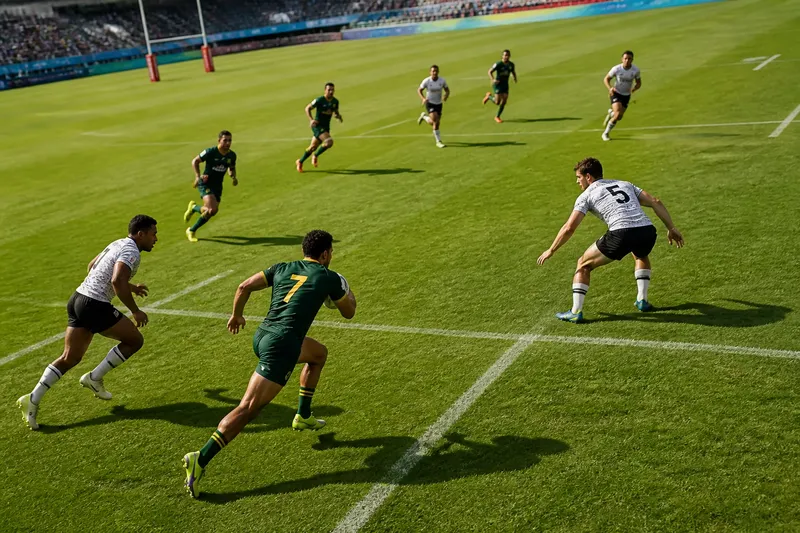
At a rugby sevens match, a ball carrier can look up after one pass and see open grass on both sides. Rugby sevens uses fewer players on a broadly full-size field than the fifteen-a-side game, so each defender must cover more ground. That changes how to read the field, not just how quickly the game moves.
Open field space
Sevens uses seven players per team, rather than the fifteen used in the standard game. The field is broadly the same size, so fewer players must defend its width and depth. Gaps can open between defenders, and an attacker who beats one opponent may face less immediate cover.
Space is not simply empty ground. It is time for a defender to decide whether to close on the ball carrier, protect an outside channel, or hold position against a support runner. With fewer teammates nearby, a wrong choice can leave a large route exposed. The same open field gives attackers room to threaten more than one route at once.
Think of a small group carrying a long couch through a doorway: each person has more room to move, but each also has more of the load to manage. In sevens, players have greater individual responsibility for both attacking and defending space.
Shared positioning
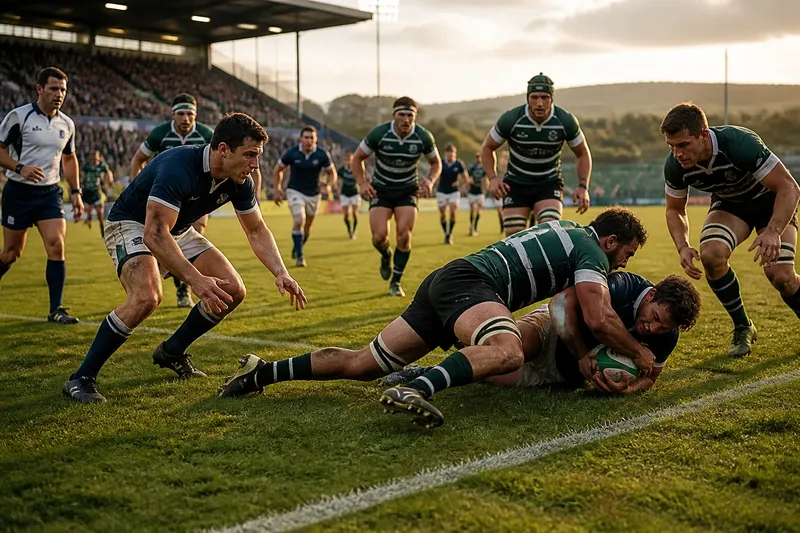
Each player has to contribute across more of the field. A defender may need to move from a wide channel toward a breakdown, then recover outward as the ball moves. An attacker may pass, support the next carrier, and later take part in a defensive phase. Positions still matter, but responsibilities overlap more than they do in a fifteen-a-side match.
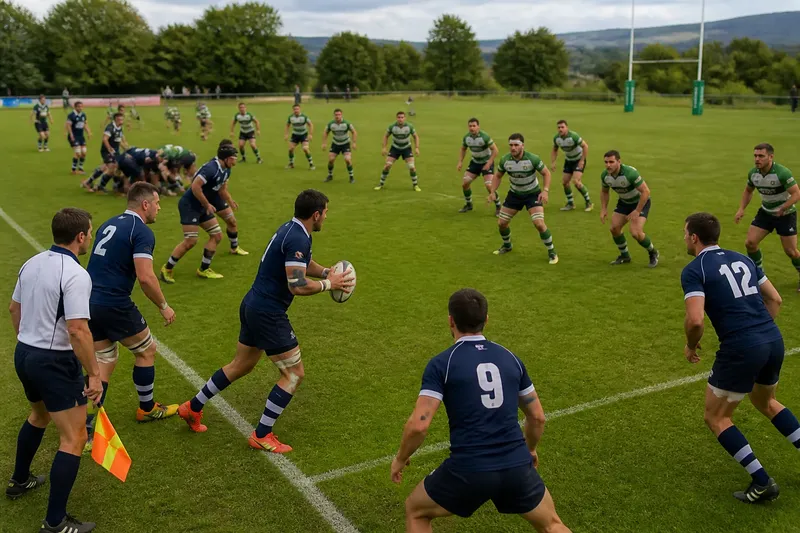
Teams may spread players to make the defense cover width, or bring them closer to keep support near the ball. Neither shape is automatically better: spreading can leave fewer players close to a contest, while clustering can make distant channels harder to protect.
For a viewer, track the defenders who are forced to choose between two threats. If one steps toward the carrier and another attacker stays available outside, the defense must decide who can cover that runner. The useful clue is not just where the ball goes, but which defender has been drawn away from a teammate.
Workload and fatigue
Sevens matches are shorter than fifteen-a-side matches, but that does not mean the physical work is light. Players repeatedly sprint into open space, change direction, make contact, and recover to take part again. With fewer teammates, there are fewer chances for an individual to leave the action while others cover the same ground.
Fatigue can affect a decision before it becomes obvious in a missed tackle. A defender may take longer to turn and cover a wide runner, or a support player may arrive late and leave the carrier isolated. In attack, a player with little room to accelerate may choose a pass sooner. These moments are easier to read as signs of workload than as sudden changes in skill.
Imagine a team that has just defended several long phases and now has to retreat across the field. If one defender is slow to reconnect with the line, an observable gap may appear nearby, giving the attack a route to threaten. The opening comes from spacing and effort together, not from fatigue alone.
Match rhythm
A shorter match compresses the time available to recover from a poor passage or build pressure gradually. A score, turnover, or penalty can quickly change what a team needs from its next possession. Teams have reason to make their attacking intent clear early, while still choosing when to keep the ball and when to play for territory.
Sevens has pauses between halves and around restarts, but live passages can be demanding because play may travel a long way before a stoppage. A brief break does not erase the distance just covered. Watch what happens immediately after play resumes: players must regain their shape while reacting to the next contest.
The rhythm is not constant speed. There are sharp accelerations, stretches of running, and moments when players reset. A team that slows its approach can be organizing support or drawing defenders into a decision; a quick restart can instead exploit opponents who have not yet spread out.
Reading rugby sevens?
Is the sevens field smaller than a fifteen-a-side field?
The playing field is broadly the same size, while each team has fewer players on it. That difference creates more space for each player to cover, even though the boundaries have not changed.
Why do players pass so often in sevens?
A pass can move the defense sideways or put a teammate into open space before defenders close it. The right choice depends on available support and defensive positions, not on passing for its own sake.
Does a shorter match make sevens less tiring?
Not necessarily: players may cover open ground at high intensity and have fewer teammates sharing the work. Shorter playing time changes the duration of the contest, not the demands within each passage.
Why can one missed defensive decision matter so much?
With fewer defenders, a teammate may be too far away to cover the space left behind. An attacker can exploit that opening before the defense has time to reorganize.
Space-reading cues
Start by looking across the field rather than following the ball alone. For each cue below, note what you can see and use it to choose what to watch next:
- Check whether defenders are spread evenly or crowded around the ball. If one side is thin, watch the attackers there; if defenders are clustered, watch for a pass that shifts play to the other side.
- Check whether a defender turns to cover a runner outside the first threat. If so, watch the space that defender leaves; if not, watch whether the carrier or support runner draws that defender next.
- Check whether a support player is available beyond the nearest defender. If so, watch for a pass after the defense commits; if not, watch whether the carrier slows to wait for support or continues alone.
- Check whether a defender is recovering after a long chase or contact. If so, watch for teammates filling the gap; if they do not, watch whether the attack targets that channel.
- Check whether the team resets its shape before a restart. If it does, follow how the line responds to the first movement; if it does not, watch for an attacker testing a space before defenders reconnect.
- Check whether two defenders are facing the same attacker while another runner stays available. If so, watch for a pass toward the uncovered runner; if not, watch which defender is responsible for that outside channel.
Say you see three attackers moving toward a channel with two defenders between them and the touchline. One attacker carries the ball, while two stay available outside. If the nearest defender steps toward the carrier, the other defender must account for the two remaining threats; watch whether the carrier passes to a runner or the defense shifts to close the lane. The expected observable result is a visible defensive choice, not a prediction that the attack will score.
Follow the next choice
Rugby sevens becomes easier to follow when you connect open field space to the choices players must make. Each time the ball moves, ask which defender has been drawn out, who is available to support, and whether the team has time to reset. That small habit reveals how one decision can reshape the next passage of play.